FastBill: how to transform a corporate website into a scalable editorial platform
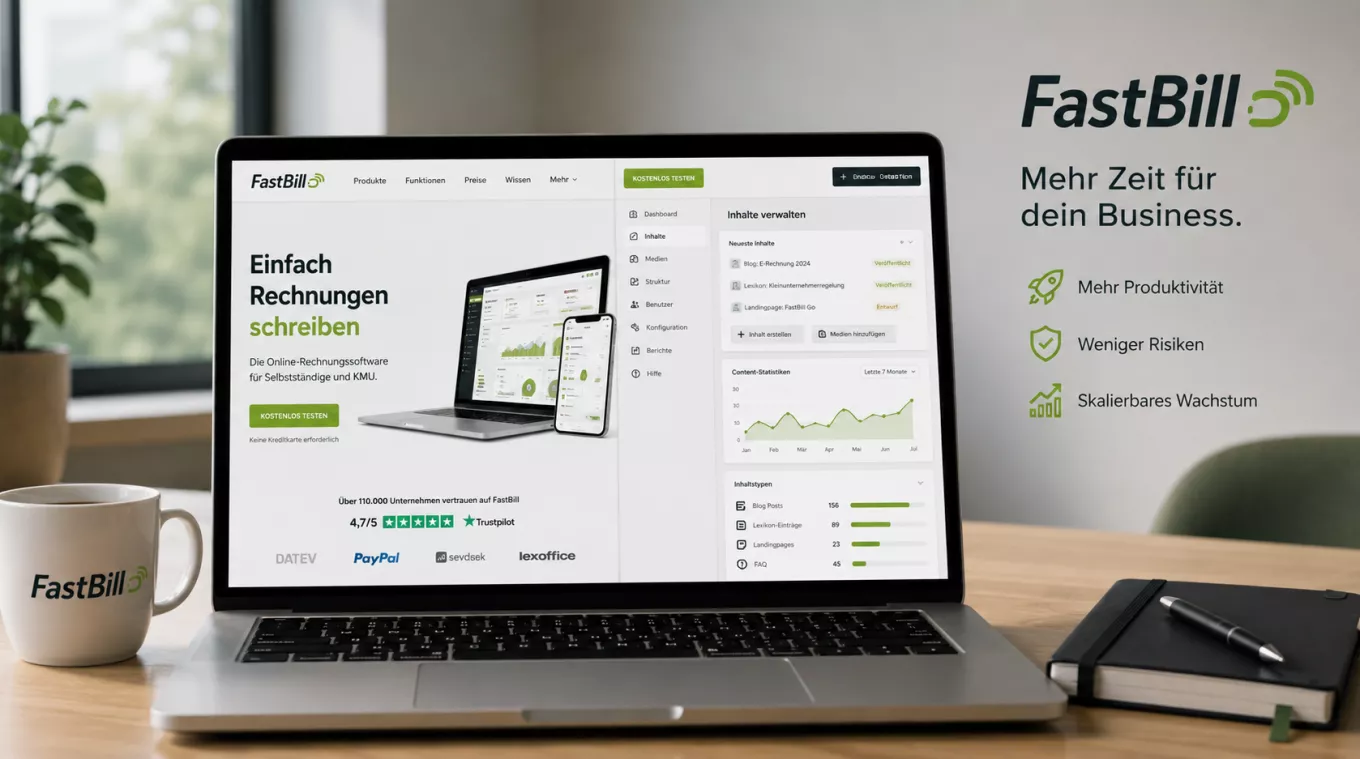
Since 2019, Natiboo has been collaborating with FastBill as a technology partner in the continuous evolution of its web platform. The project began with evolutionary improvements on a Drupal website with little editorial structure, non-standardized code, and limited publishing processes.
Over time, that collaboration turned into a profound transformation: creation of an editorial architecture based on reusable components, improvement of the blog, development of core pages, implementation of Media, technical SEO, structured data, performance optimization, evolution to Drupal 10, security reinforcement, and continuous improvement of the editorial experience.
The result is a more stable, flexible, and productive platform, designed for the FastBill team to publish, structure, and optimize content with greater autonomy, lower risk, and more capacity for evolution.
FastBill is one of the leading European solutions for online invoicing. Since 2019, at Natiboo we have collaborated with their team as a technology partner to evolve their web platform, improve their editorial processes, and build a technical foundation capable of supporting their growth.
What started as a collaboration to make evolutionary changes ended up becoming a long-term relationship: a sustained evolution of the platform, its internal tools, and its ability to publish content with more quality, speed, and less risk.
The starting point: a website that needed to evolve
When we began working with FastBill, the platform was already built on Drupal, but it did not have a sufficiently mature editorial architecture. The code did not follow clear standards, maintenance was limited, content management was basic, and the visual structure relied on outdated templates and styles.
The problem was not the editorial team. On the contrary: FastBill had an excellent team. The issue was that the platform did not provide the necessary tools for that team to work with the autonomy, depth, and quality they needed.
Publishing content was slow. Reusing structures was difficult. Creating pages with a polished visual presence required too much effort. And each evolution carried risks stemming from a technical foundation that was ill-prepared for growth.
The challenge: improving productivity without breaking the platform
In many digital projects, the challenge is not to build a new website from scratch, but to transform an existing platform without interrupting its activity. That was the case with FastBill.
It was necessary to improve editorial capacity, reinforce stability, introduce development standards, reduce errors, and prepare the platform for new business needs. All of this on an already active system with real needs for marketing, SEO, content, and conversion.
Our goal was not just to resolve tickets. It was to build a platform that allowed for better work.
An editorial architecture based on reusable components
The first major line of work was to provide FastBill with a more flexible editorial architecture. To achieve this, we developed an ecosystem of reusable components based on Paragraphs, designed to allow the creation of richer pages without constantly relying on custom development.
This evolution enabled the creation of reusable content modules, improved visual consistency, and reduced friction in the publication of new pages.
We also implemented Media to facilitate the reuse of images and graphic assets, avoiding duplications and improving internal content management.
Over time, this architecture expanded with new types of content, flexible modules, injectable components, more user-friendly editing systems, and mechanisms aimed at facilitating the daily work of the editorial team.
From basic content to a complete editorial platform
The evolution of FastBill was not limited to improving existing pages. A much deeper editorial platform was built, capable of supporting an ambitious content strategy.
Among the main improvements developed are:
- Design and implementation of a more structured blog.
- Creation of core pages or pillar pages.
- Mechanisms for related posts.
- Calculation of reading times.
- Improvements in categories, listings, and editorial navigation.
- More robust management of images and reusable content.
- Systems for shortcodes and insertable components.
- Continuous improvements in editing experience.
The result was a more productive platform: not only a more modern website but a better tool for the team that had to work with it every day.
Technical SEO, structured data, and preparation for the future of search
An important part of the evolution of FastBill has been strengthening its SEO foundation. Throughout the collaboration, improvements have been implemented in metadata, URLs, redirects, sitemaps, microdata, structured data, and indexing control.
Advanced capabilities based on JSON-LD and specific schemas for different types of content, including articles, FAQs, organization, product, and reviews, were also developed.
In a more recent phase, this technical foundation allowed for the formulation of an advanced SEO and GEO strategy aimed at the new search landscape driven by artificial intelligence. The idea was no longer just to perform better on Google, but to prepare the platform to be understood, cited, and reused by search engines and AI-based systems.
This demonstrates one of the keys to the collaboration: it is not just about maintaining a platform, but about turning its technical foundation into a strategic advantage.
Stability, performance, and continuous maintenance
In addition to the editorial layer, the work included a constant improvement of the stability and maintainability of the system.
Updates to Drupal core and contributed modules were made, improvements in deployments, configuration adjustments, security reinforcements, cache optimizations, frontend bug fixes, mobile accessibility improvements, and progressive evolution to Drupal 10.
This type of work is rarely visible to the end user, but it is essential for a platform to continue growing without accumulating technical debt.
A critical incident: when the cache started to fail
One of the most delicate moments of the collaboration involved the cache. For weeks, we worked hand in hand with the FastBill technical team because the cache was being invalidated without an apparent cause. This caused severe performance issues and made the platform behave unpredictably.
The solution was not to apply a quick patch. We broke the problem down into micro-problems, systematically analyzed hypotheses, and narrowed down the origin until we found the real cause.
This type of work reflects our understanding of engineering well: it is not enough to resolve symptoms. One must understand the system, reduce uncertainty, and tackle the problem at its root.
Collaborating as a partner, not as a one-time provider
The relationship with FastBill has gone through different phases. At times it has required more intense meetings; at others, weekly or biweekly checkpoints. But it has always maintained a constant: clear communication, trust, and a very well-structured workflow.
FastBill is a client that specifies with great precision, which greatly facilitates collaboration. From there, our job is to provide technical criteria, anticipate risks, propose solutions, and turn business needs into real tools.
We have not limited ourselves to implementing functionalities. We have helped shape editorial processes, improve team productivity, and reduce operational risks.
Results: a more productive and less fragile platform
After years of collaboration, FastBill has a much more solid, flexible platform ready to evolve.
The main improvements can be summarized in five areas:
- Greater editorial autonomy.
- Less dependence on specific developments for each page.
- Greater speed in creating and publishing content.
- Reduction of incidents and technical risks.
- Foundation prepared for advanced SEO, structured data, and AI-based search.
The real value lies not in an isolated functionality, but in the sum of all of them: a unique editorial platform designed for the team to work better.
Learnings
FastBill has allowed us to delve into an idea we consider central: a good platform is not only one that looks good from the outside, but one that allows for good work from the inside.
We have learned to model complex editorial flows, to turn marketing needs into reusable technical structures, and to balance flexibility, control, and maintainability.
We have also reinforced a conviction: software development adds more value when it is not limited to executing instructions, but when it helps the client better understand their own processes.
Conclusion
The case of FastBill is not simply a story about Drupal, SEO, or reusable components.
It is a story about productivity.
About how a poorly maintained platform can become, with continuous work and technical criteria, a solid tool for the team that uses it every day.
After years of collaborating with FastBill, we continue to develop new capabilities for their platform. For us, a project does not end when a functionality is published. It advances every time the client can work better, with less friction and more confidence in their own tool.
Related articles

Más allá de una web corporativa: Drupal 11, IA, WebMCP y experimentación en un único sistema
Replantear una plataforma para multiplicar su impacto social: el caso Labdoo

Evolución de un e-commerce complejo: el caso de Bodeboca