How much does it cost to modernize legacy software: cost factors, models, and real estimation
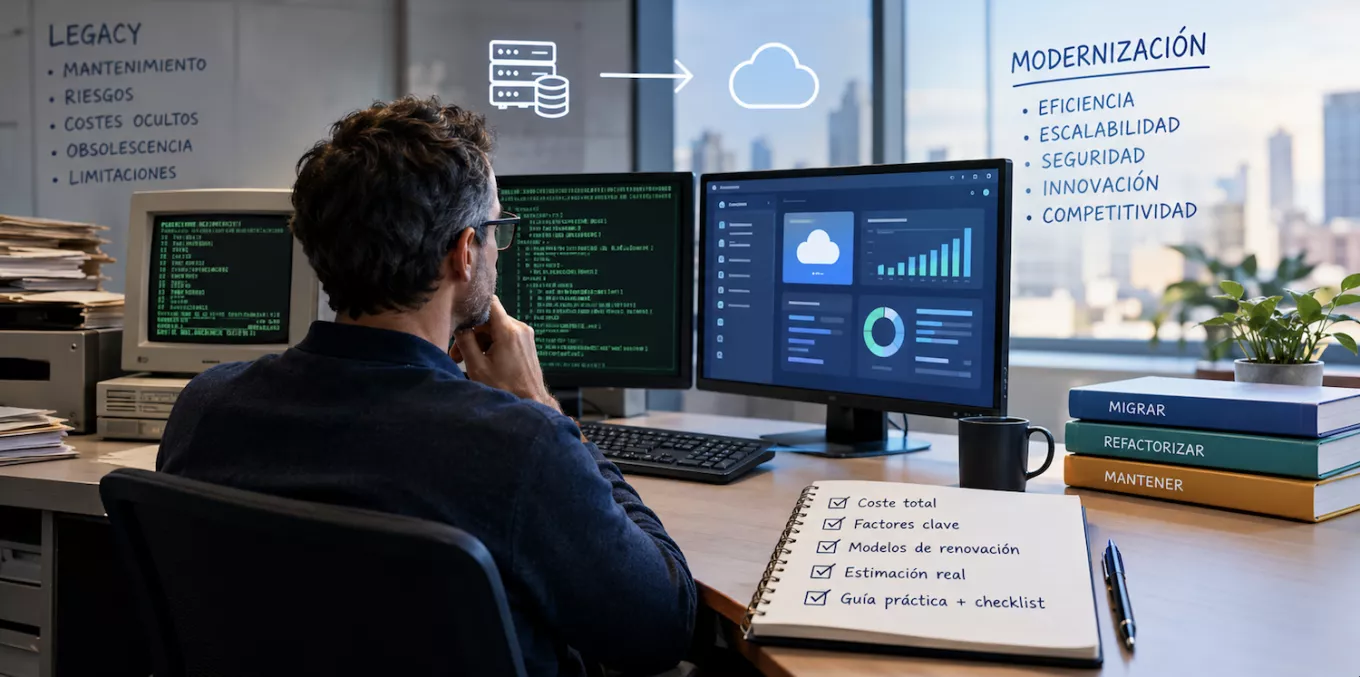
Sooner or later, your IT department will have to answer the question of how much it will really cost to modernize your legacy software. While there is no fixed cost, there are criteria that are. We will tell you about them.
You have been using a software tool for years that has allowed you to work and grow without problems until now. It was made for you, and with small periodic updates, it has been enough. It is a legacy, something inherited with all the value of your organization, known for that by the name in English, Legacy. But now, it has become obsolete for everything you do, or the system it runs on has stopped being supported by the developer, and you will no longer be able to update it. So, you are left wondering whether it is worth updating software that has become obsolete or if you can continue with what you have because the remedy might be worse than the disease. What if you could keep using it for a few more years?
Sometimes you have no choice, and if your systems use highly customized applications, you may have no other option. Or because the person managing your technology now does not know or does not have the key to those legacy solutions. But even if there is a more modern alternative, the decision may be conditioned by something as prosaic as the necessary budget and whether you consider patching your old solution again. At first glance, we do not know which of the two options is best for you, but sooner or later your IT department will have to answer the question posed by the board of directors about how much it will really cost to modernize your legacy software.
The short and honest answer is that there is no fixed standard price. It is not that there is no hourly or goal-based rate; more or less, there is, as in all sectors, an average market price, although not standard. What does not exist is a single solution or answer to all cases, and trying to give a figure without prior analysis can lead you into the trap of opaque proposals that are either inflated just in case or fall short and end up in massive budget overruns.
In fact, analysis firms like Gartner or Standish Group believe, after studying the market, that most modernization projects budgeted as a "black box" suffer cost overruns of between 50% and 200%, or end up being canceled before seeing the light.
On the other hand, there is a cost of inaction, the one you generate by not modernizing your systems on time, such as constant corrective maintenance, service outages, security breach risks, and the difficulty in finding technical talent willing to work with obsolete code, which often far exceeds the investment in modernization.
Returning to the initial question of how much it will cost you to modernize your legacy software, starting from the premise that the less, the better, the most honest answer is to avoid cost overruns by understanding what factors determine the price, what modernization models exist, and how to calculate the return on investment (ROI). We will summarize them simply to help you make decisions.
The 5 technical factors that determine the real cost
The first thing you should know is that the modernization budget of a legacy system is not calculated by the number of screens or users, but by the hidden complexity in its architecture. The main determinants are:
- Degree of technical debt and code coupling: Many times we encounter what we call "spaghetti" code, with a tangled, confusing, and disorganized structure that is difficult to untangle, without automated tests or documentation. This requires an initial phase of reverse engineering to map the business rules before touching a single line of code.
- Number and complexity of integrations: If it is a closed and internal use solution, it is not the same as if there are critical connections to maintain with third parties, such as ERP programs, CRMs, payment gateways, or proprietary APIs that cannot stop functioning during the transition. This increases the cost.
- Chosen modernization strategy: There are three essential options for legacy migration, and each has a different cost, although it cannot always be chosen solely based on price; it will depend on your reality. The initially most economical option is Rehosting, or moving the system to the cloud as is. In reality, this means that the current software basically works and does not eliminate any technical debt inherited. The second option is Progressive Refactoring (Strangler Fig Pattern). Here, the system is replaced module by module behind an API facade. The investment is spread over time, the work too, and the risk is minimal. Finally, the deepest option is Full Rewrite, and is therefore the most expensive and risky option, as it requires duplicating efforts to achieve "feature parity" while the old system continues to receive changes.
- Data migration and sanitization (ETL): Another factor influencing the price is whether it is necessary to structure, clean, and transfer old relational databases or those with inconsistent formats to a modern architecture, which requires developing custom extraction, transformation, and loading scripts.
- Governance and knowledge transfer: A project of this magnitude, to be complete, does not end with the delivery of the code. The budget should include technical documentation and training for the internal team to ensure future autonomy. This policy, typical of In-sourcing, will save you future costs every time you need to tweak or expand your new code. You will be ensuring your future legacy today.
The "Hidden Cost" of black box proposals
And here we have touched on a key point when thinking about updating or migrating your current technology. Like any custom product or service, it is important to know what you are really contracting, what it covers, and what it does not. When comparing closed budgets, whether or not there are substantial differences in price, you should check if they are attractive at the beginning but will end up costing you more in the long run. In legacy software, blind closed specifications often lead to two typical problems: the loss of implicit functionalities and vendor lock-in. Make sure that the provider has everything clear in case they did not detect an undocumented business rule and will later charge you for each adjustment as an "extra" outside the contract. And also that they will not deliver a closed solution where your internal team does not understand the new architecture or possess the documentation, leaving you tied to that provider for any future maintenance.
Decision checklist before approving a budget
To help you make that important decision, which can have economic consequences not only due to the costs of migration but also due to possible production stoppages if the project is not completed on time and as agreed, before giving the green light to a legacy software modernization proposal, make sure it answers these questions affirmatively:
- Does the budget include a prior architectural diagnosis phase?
- Does the strategy respect the accumulated value in the previous business logic (legacy)?
- Is the migration planned in progressive phases without requiring production stoppages?
- Is the periodic delivery of source code, documentation, and intellectual property rights contemplated?
- Does the working model guarantee the transfer of knowledge to your internal team?
The Natiboo approach: Internalist Diagnosis and ROI Roadmap
At this point, you will have understood that facing an update of your systems is not like going to a supermarket and buying a pack. There are no preconfigured solutions. Therefore, the first thing is to understand what your need is, starting from a vision that we define as that of a "internal medicine doctor" of systems, who analyzes every past, present, and foreseeable future aspect of the specific needs and the solutions they require.
Discovering what remains valuable or necessary from what you currently use, studying how to preserve it, or whether it is necessary to remove it.
Only then can we address the cost of modernization with criteria and transparency, avoiding inflated budgets and last-minute surprises.
The model we propose is based on three financial and operational pillars:
1. Prior Internalist Diagnosis (Pre-study)
Before committing large budgets, we conduct an initial audit of the platform to map the legacy code, detect critical dependencies, and define which parts of the system should be preserved and which should evolve. This allows us to narrow down the real scope with data in hand.
2. In-Sourcing Model and milestone-based budget
Instead of a "black box," we integrate with your team in an In-Sourcing mode. The investment is distributed in sprints of work with clear and functional deliverables. Each milestone adds measurable value to the business (ROI), allowing for the reevaluation of priorities at all times.
3. Guarantee of ownership and independence
All development, technical documentation, and keys to the architecture are transferred to your organization from day one. By betting on open standards and solid technologies, we ensure that your company maintains total control of governance and source code, eliminating any dependence on third parties.
Don't wait until it's too late; it will be more expensive
If you need to update your systems, do not let budget uncertainty or technical debt continue to hinder your organization's growth. Start by evaluating the real cost of modernizing your platform. Request a technical diagnosis and pre-study of your legacy software with our senior team. We will analyze your system's architecture and outline a secure, transparent modernization roadmap focused on return on investment.
In the meantime, you can discover how we approach the modernization of complex environments in our Success Cases or explore our proposal for Migrations and modernization of legacy applications.
Related articles

How we turn real problems into open source solutions for Drupal

Evolution of a complex e-commerce: the case of Bodeboca

Reconceptualizing a platform to multiply its social impact: the Labdoo case
