Modernizing a legacy application. Complete guide to decide, estimate, and keep the business running
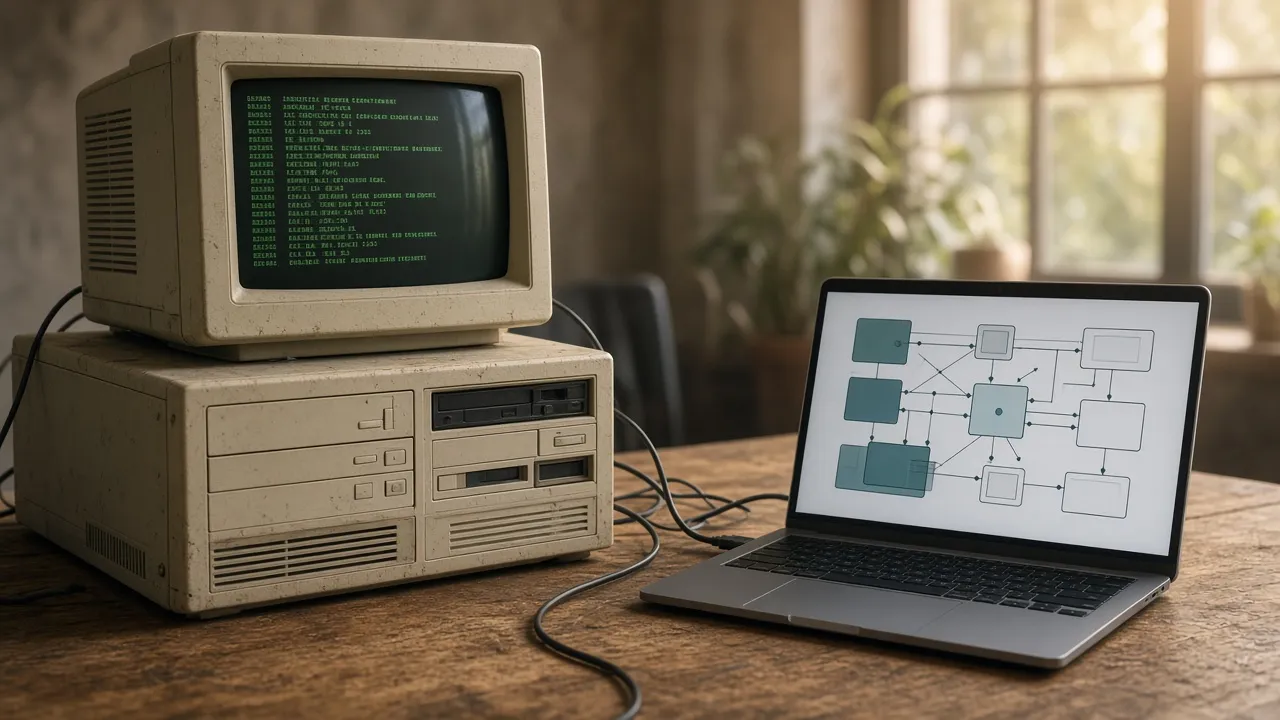
Almost all companies have an application that no one wants to touch. It works, generates invoices, and supports the business, but every time someone suggests changing it, an awkward silence falls over the meeting. In this guide, we discuss when it is worth modernizing it, which path to choose, and how to do it without halting operations, based on what we have seen in real projects (there are no magic recipes, we warn you).
Let's say something that many providers won't like. Most legacy applications shouldn't be discarded; they need to be understood, and that requires significantly more work than starting from scratch, as it forces you to read other people's code, to ask what a field called temp2 is for, and to discover that the most important billing rule of the company is not documented anywhere. But there, in that ugly code, is usually the business knowledge.
However, sometimes it does need to be discarded. We have done it too, and we explain it further down.
What is a legacy application?
Legacy means heritage, that is, the software you inherit. It was created by another team, another provider, or yourself ten years ago, and it has grown through patches. It has less to do with age and more with condition. A three-year-old application without tests, without documentation, and whose author is no longer with the company is more legacy than a well-maintained fifteen-year-old one.
Typically, it has a bit of all this. Spaghetti code with business logic scattered everywhere, a framework or CMS without support (Drupal 7 lost it in January 2025 and Drupal 10 will lose it on December 9, 2026), integrations with the ERP, CRM, or payment gateway that no one dares to touch, undocumented custom modules, a database with formats from various eras, and, hopefully, one person who knows how everything fits together. With bad luck, none.
When the moment has arrived
"If it works, don't touch it" is good advice until it stops being so. How do you notice? Well, the manufacturer withdraws support and there are no more security patches, every small change takes weeks, the same errors recur in every campaign, performance drops right at month-end or on Black Friday, no one understands the entire system because the original developer left, you want to add a new integration (or a bit of AI, which everyone wants now) and the architecture doesn't allow it without breaking something else, or you depend on a provider who gives you neither the code nor the documentation.
Not all of these need to be met.
The phrases we hear when someone calls us are very similar. "The website works, but no one dares to touch the database." "We've received outrageous quotes and we don't know how to evaluate them." Does any of this sound familiar?
Doing nothing also costs, although that cost doesn't come in a bill. It comes distributed in corrective maintenance, in security scares, and in the fact that there are fewer and fewer people willing to work with that technology. And the longer you wait, the less margin you have to choose, because it's not the same to plan a migration calmly as it is to do it hurriedly because a vulnerability has emerged without a patch. If business continuity is not at stake, then it can be studied calmly.
What is most frightening
If you ask any manager what worries them about modernization, the answer is obvious. That the continuity of service is interrupted. We usually work with critical systems where downtime or outages cannot be afforded, and no one loses sleep over the framework; they lose sleep over not being able to bill on Monday.
The way to solve this is no secret. Analyze well what you want to do, implement following best practices, execute thorough tests, have an ecosystem of testing and validation environments that allows anticipating any errors, have playbooks for the customer service team, and contingency protocols in case errors arise. Which they will, by the way.
In day-to-day operations, this translates into short phases instead of a big bang, allowing the old and the new to coexist for a while, synchronizing at the end the orders or users created during the migration, and notifying everyone who depends on the system, because a perfect integration can fail just as easily if someone from another department didn't know it affected them.
There is an example of this approach in the migration from Drupal 7 to Drupal 11, and another in the implementation of Checkout.com on a legacy e-commerce, which we did without interrupting the service.
Migrate, refactor, or rebuild
There are decision frameworks of all kinds, from large cloud providers and consultancies, and sometimes they complicate more than they clarify. We simplify it into three paths.
Migrating is moving the application to another platform or server while minimally touching the code. It works when the problem is the infrastructure and the application itself is functioning well. What it doesn't do is eliminate technical debt (if the code is bad, it will still be bad on the new server).
Refactoring in parts means changing the internals without changing what the application does or stopping it. It fits when the accumulated logic is valuable, and it is the path with the least risk, although not the fastest, which is not always easy to defend in a management committee. Martin Fowler gave it a very graphic name, the strangler fig pattern. A facade is placed in front of the old system, the new is built behind it module by module, and traffic is gradually diverted until one day the monolith is turned off and no one notices.
And then there is rebuilding from scratch, which many people think we always advise against. Well, no. We have done it many times, for example with Labdoo. When a system wants to evolve or scale, it is often advisable to propose a new architecture from scratch. What we ask is that it be justified by what the business needs, not for the convenience of whoever is going to program it or for a simple version change, and that the trap of parity is taken into account, which is when the old system remains alive and changing while the new one tries to catch up.
Many times the answer ends up being a mix of the three. The complete reasoning is in Migrate, refactor, or rebuild a legacy application?.
Two mistakes we see repeated
When a company tries to modernize on its own, we mainly see two.
The first is trying to go too fast. A date is set, pressure is applied, tests are cut, and the migration goes through, yes, but with holes that are much harder to fill later.
The second is trying to maintain obsolete functionalities, processes, or requirements that a migration helps to optimize or eliminate. A screen that no one uses anymore is copied as is, or a process that only existed due to a limitation of the old system, and the opportunity to clean up is lost. Is that report that is exported every Monday and no one opens really necessary?
Before requesting a quote (and how much it costs)
Requesting a quote without having looked at the system is like asking a mechanic for a price over the phone. They will give you one, of course.
There is no standard price for modernizing a legacy application, and anyone who gives you a figure without looking at the system is either inflating it or will fall short. What matters is not the number of screens or users but the complexity that is not visible, that is, the technical debt, how many integrations there are and how painful they are if they fail, the chosen path, the state of the data to be migrated, and the transfer of knowledge, which if not budgeted will end up being paid later. We explain this in more detail in How much does it cost to modernize an enterprise legacy application?.
Before comparing proposals, we review six types of things. Accesses, environments, versions, documentation (if it exists), the people who still remember how everything fits together, and the restrictions, those dates or rules that cannot be skipped. If you prefer someone from outside to look at it, our technical audit also covers whether you really control your platform.
And before signing, a few questions. Does the proposal include a diagnostic phase? Is it phased or is it a big bang? Do they deliver the code, documentation, and rights during the project or only at the end? Will your team understand what they leave behind? We budget by milestones, with a pre-study that scopes the project and then sprints with clear deliverables.
Four projects, four decisions
Bodeboca. We entered Bodeboca with a very specific task, to design and implement an automated invoicing system for suppliers, something that had previously been done manually. This allowed us to enter the migration of a legacy system in Drupal 6 that is still functioning today and billing millions of euros a year. To give you an idea of the project's magnitude, the migration started as a move to Drupal 8 and we are now on Drupal 10. We have been working with them since October 2020, integrated into their team, and we have done all this without stopping a marketplace with over 2 million users and campaigns like Black Friday. Read the Bodeboca case.
FastBill. We have been with FastBill since 2019. What we can share is their website in Drupal (the billing product is another story). It started as a corporate website with little editorial structure and has ended up as an editorial platform with reusable components, technical SEO, and the transition to Drupal 10, so their team can publish with more autonomy. There was a time when the cache was invalidating for no apparent reason, and we spent weeks with their team until we found the source. That doesn't appear in brochures. Read the FastBill case.
Canary Islands Tourism, alongside Lutech. Between July 2025 and February 2026, we developed with Lutech the new website in Drupal 11, multi-language and accessible. It was a joint effort, and that's how we tell it.
Labdoo is the opposite case. We have been with them since January 2024, and the initial request was to migrate their platform from Drupal 7 to Drupal 10. Upon analyzing it, we saw that a conventional migration would have dragged years of technical debt, with highly customized entities, complex rules, sixteen languages, and logistical and social processes spread across half the world. So we proposed a new architecture from scratch. Today the platform is finished, awaiting launch. Read the Labdoo case.
What do they have in common? That in all four we had to understand the system before deciding anything. There are more anecdotes from these projects, but they are confidential and will remain so. You can find more projects in success stories.
The code must be yours
Many applications end up being legacy due to how they were contracted. A provider does the work, keeps the key, and no one inside knows how it works, until years later that provider changes, raises prices, or disappears. And back to square one.
That's why we work on in-sourcing. We integrate with your team, transfer knowledge, and give you the code, documentation, and architectural decisions. We explain it in in-sourcing vs outsourcing and in what technological sovereignty is.
If we didn't build your platform, that's okay; it's the most common scenario. And once modernized, it needs to be maintained so it doesn't become legacy again in a few years, which is what maintenance and evolution is about.
Where to start
The first step is not to choose technology. It is to know the state of what you have.
We have been working since 2010 with a senior team, and an experienced person reviews and signs everything we deliver. We explain this in how we work, and what we do in these projects is in modernization of legacy applications and migrations.
Frequently asked questions
It's inherited software that still supports the business but has fallen behind. That may be due to unsupported technology, missing documentation, technical debt, or because nobody understands how the whole thing works anymore. It depends more on its condition than on its age.
When the vendor withdraws support, when every change takes too long, when errors keep coming back or performance fails at critical moments, or when you depend on a provider who won't give you the code. If none of that is happening and operations aren't at risk, you can study it calmly.
There is no standard price. It depends on the technical debt, the integrations, the chosen approach, the state of the data and the knowledge transfer. That's why it makes sense to start with a diagnosis and a milestone-based budget.
It depends on the problem. If the infrastructure is failing and the application works well, migrate. If the logic is valuable but the internals are outdated, refactor in phases. If the system needs to evolve or scale and its foundations can't take any more, consider a new architecture from scratch, as we did with Labdoo. It's often a mix.
Yes. With prior analysis, good practices, thorough testing, test and validation environments, customer support playbooks and contingency protocols. At Bodeboca the Drupal 6 system keeps running while we migrate, and we're already on Drupal 10.
It depends, and we're not dodging the question. The timeline is set by the size and state of the code, how many integrations there are, how much data needs to be migrated and cleaned, and how fast the business can absorb changes without stopping. We don't give timelines until we've looked at the system. What does have a fixed timeline is the first step. The Second Opinion takes 5 working days and the Express Audit takes 10.
Yes, it's the most common case. We start by reviewing the code, the environment and whatever documentation exists, so we know what we're taking on and what risks it carries.
Yes. We work on an in-sourcing basis and hand over the code, the documentation and the knowledge, so you don't depend on us or anyone else.
Related articles

How much does it cost to modernize a legacy enterprise application? Factors, models, and real estimation
Migrating, refactoring, or rebuilding a legacy application? A decision framework for IT executives

Evolution of a complex e-commerce: the case of Bodeboca

Reconceptualizing a platform to multiply its social impact: the Labdoo case
Implement Checkout.com in a legacy e-commerce without interrupting the service
A preliminary review of your application
It's free. We look at what can be seen from the outside and have a short conversation with you. We don't ask for access and it isn't a full audit.
If you need to dig deeper
There are two packs. The Second Opinion takes 5 working days and includes a report and a call. The Express Audit takes 10 working days and includes a prioritised report and the handover.